 ️
️ Upsert (append ... or replace)
Upsert is ObjectQuel's insert-or-update statement — append ... or replace ... combines
append and replace into a
single statement, run through the same EntityManager::executeQuery() entry point as
retrieve. It bypasses the identity map and change tracking entirely, the same as a standalone
append, replace, or delete.
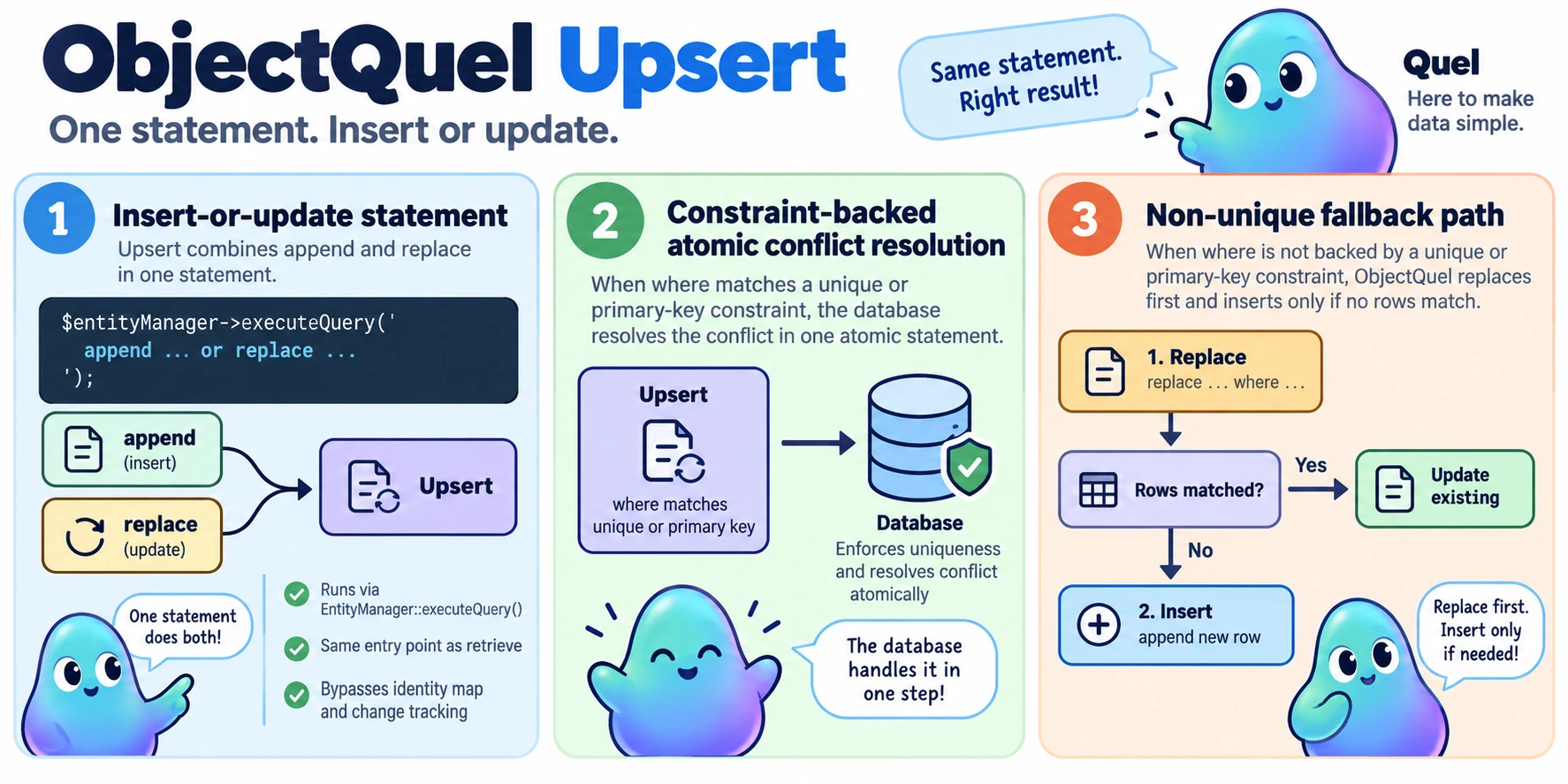
Upsert: Insert-or-Update in One Statement
append ... or replace ... appends this row, or replaces the row(s) where matches
instead. When where's columns exactly match a declared unique or primary-key constraint, this
compiles to a single dialect-native atomic statement — the database itself resolves the conflict. Any other
predicate on any field still works, just without that database-level atomicity guarantee — see "Matching on
a Non-Unique Field" below.
$entityManager->executeQuery('
    range of u is App\Entities\UserEntity
    append to u (email = :e, name = :n) or replace (name = :n) where u.email = :e
', ['e' => 'alice@example.com', 'n' => 'Alice']);
The where names the conflict target explicitly. or replace's assignment list is
itself optional — when omitted, a conflict overwrites every appended column, except the target's
primary key, with the row that would have been inserted, which is the common case and the whole
reason repeating the values would otherwise be needed. The primary key is always left out of this default
overwrite, even when one was supplied on the insert side, so a conflict can never clobber an existing row's
real identity with a freshly generated or supplied one:
$entityManager->executeQuery('
    range of u is App\Entities\UserEntity
    append to u (email = :e, name = :n) or replace where u.email = :e
', ['e' => 'alice@example.com', 'n' => 'Alice']);or replace (...) list for that case.
Write an explicit list only when the conflict-time update must differ from the insert — for example, incrementing a counter instead of overwriting it:
$entityManager->executeQuery('
    range of u is App\Entities\UserEntity
    append to u (email = :e, views = 1) or replace (views = u.views + 1) where u.email = :e
', ['e' => 'alice@example.com']);
A multi-row append ... or replace upserts each row independently, using that row's own values
on conflict — this requires where to be backed by a real unique/primary-key constraint (the
atomic path): a non-unique-backed where has no per-row conflict target for the database to
resolve independently, so a multi-row append using one is rejected at compile time — see "Matching on a
Non-Unique Field" below.
$entityManager->executeQuery('
    range of u is App\Entities\UserEntity
    append to u
        (email = :e1, name = :n1),
        (email = :e2, name = :n2)
    or replace where u.email = :e1
', ['e1' => 'alice@example.com', 'n1' => 'Alice V2', 'e2' => 'carol@example.com', 'n2' => 'Carol']);
The Atomic Path: a Real Unique Constraint
When where's columns exactly match a declared unique or primary-key constraint, the statement
compiles to a single dialect-native atomic statement — the database itself enforces the uniqueness and
resolves the conflict in one round trip:
/**
 * @Orm\Table(name="users")
 * @Orm\UniqueIndex(name="idx_unique_email", columns={"email"})
 */
class UserEntity { ... }
Matching on a Non-Unique Field
where isn't restricted to a unique or primary-key column — any predicate a standalone
replace supports works here too, on any field. There's no
dialect-native atomic form to compile to in this case (the database has no constraint of its own to resolve
the conflict against), so ObjectQuel runs the equivalent of a plain replace ... where ... first;
only when that matches no rows does it fall back to inserting the new one:
$entityManager->executeQuery('
    range of u is App\Entities\UserEntity
    append to u (email = :e, name = :n) or replace (name = :n) where u.status = :s
', ['e' => 'alice@example.com', 'n' => 'Alice', 's' => 'pending']);
This is bulk and set-based, same as a standalone replace: if where matches
several rows, all of them are updated — that's intentional, not an error, and nothing is inserted whenever
at least one row matched.
append (...), (...) or replace where <cond> is rejected at compile time when
<cond> isn't backed by a declared unique/primary-key constraint — a single shared
where can't identify which literal row it's matching against per row the way a real
constraint lets the database resolve independently. Write single-row statements instead, or back the
conflict target with a real constraint for a multi-row atomic upsert.
where takes the atomic path is checked purely against the entity's declared metadata
— @Orm\UniqueIndex/primary-key annotations — never the live database schema or the actual
data. A column that happens to hold unique values without a matching annotation still takes the fallback
path above; conversely, an annotation that no longer matches the real table (say, the index was dropped
outside ObjectQuel) still takes the atomic path, and can fail or misbehave at runtime, since the
constraint's physical existence is never verified.
Dialect Notes
These apply to the atomic (constraint-backed) path only — the fallback above compiles to the same
UPDATE/INSERT pair on every dialect, with no per-dialect branching at all:
| Dialect | Compiles to |
|---|---|
| pgsql / sqlite | INSERT ... ON CONFLICT (cols) DO UPDATE SET ... — scoped to exactly the named columns. |
| mysql / mariadb |
INSERT ... ON DUPLICATE KEY UPDATE .... MySQL's form has no column-scoping: this fires
on any unique-key collision on the table, not only the columns named in the QUEL
where. A real, documented dialect gap, not something ObjectQuel can compile around.
|
| sqlsrv | MERGE ... WHEN MATCHED THEN UPDATE ... WHEN NOT MATCHED THEN INSERT ... |
ON DUPLICATE KEY UPDATE reports 2 affected rows (not 1) when a row was
updated via the duplicate-key path — a well-known, documented MySQL quirk in the driver's row count, not a
bug in the generated SQL.
Working with the Result
Upsert returns a QuelResult with no fetchable rows — getAffectedRows() and
getGeneratedId() are the accessors that matter here, the same as for a standalone
append:
$result = $entityManager->executeQuery($query, $parameters);

$affected = $result->getAffectedRows();
$newId    = $result->getGeneratedId(); // null unless a row was actually inserted
For upserts on the atomic (constraint-backed) path, getGeneratedId() is
populated only on mysql/mariadb when the row was actually inserted; Postgres, SQLite, and SQL Server cannot
distinguish inserts from conflict updates, so it remains null. On the fallback
path, ObjectQuel knows whether the insert ran, so getGeneratedId() is populated whenever it
did, on every dialect.
Scope & Limitations
- A multi-row
append ... or replacerequireswhereto be backed by a real unique/primary-key constraint — see "Matching on a Non-Unique Field" above. - No
RETURNING/output-clause support — the generated primary key comes back viagetGeneratedId(), not a SQL-levelRETURNING/OUTPUTclause. MySQL has no native equivalent toRETURNINGat all.