 ️
️ Indexing System
Master ObjectQuel's indexing system to optimize database performance through annotation-driven index management, automated migration generation, and intelligent query optimization strategies.
Index Fundamentals in ObjectQuel
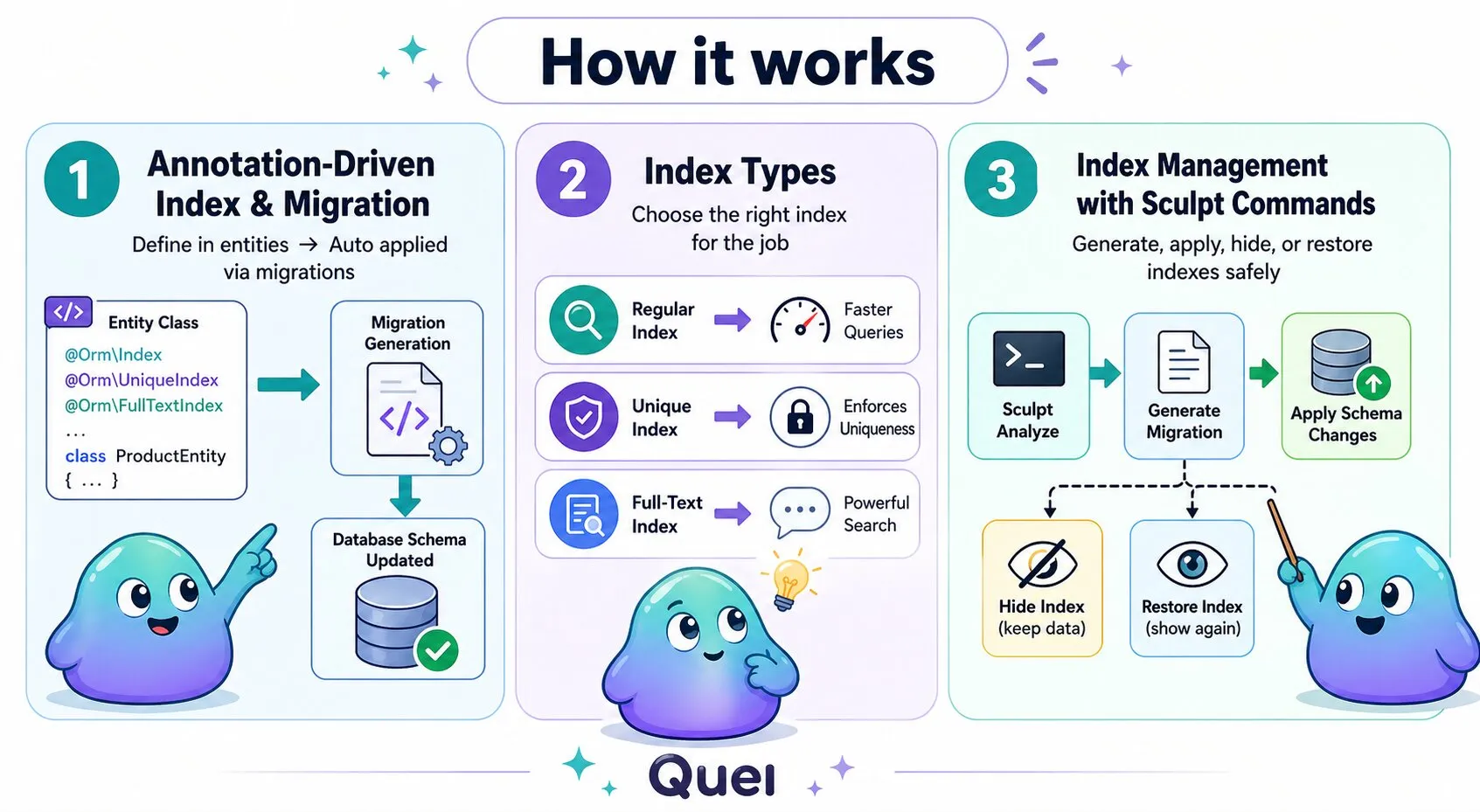
ObjectQuel's indexing system allows you to define database indexes directly in your entity classes using annotations. These annotations are automatically processed during migrations to create, modify, or remove indexes in your database:
/**
 * @Orm\Table(name="products")
 * @Orm\Index(name="idx_price_range", columns={"price", "categoryId"})
 * @Orm\UniqueIndex(name="idx_unique_sku", columns={"sku"})
 * @Orm\FullTextIndex(name="idx_ft_product_content", columns={"name", "description"})
 */
class ProductEntity { ... }
Key Benefits:
- Define indexes alongside entity definitions for clear documentation
- Automatic migration generation for index changes
- Type safety and IDE support for index definitions
- Version control friendly - indexes are tracked with your code
Regular Indexes with @Orm\Index
Regular indexes improve query performance for properties frequently used in WHERE clauses, JOIN conditions, or ORDER BY operations:
Single Column Indexes
/**
 * @Orm\Table(name="users")
 * @Orm\Index(name="idx_email", columns={"email"})
 * @Orm\Index(name="idx_status", columns={"status"})
 * @Orm\Index(name="idx_created", columns={"createdAt"})
 */
class UserEntity { ... }
Composite Indexes
/**
 * @Orm\Table(name="orders")
 * @Orm\Index(name="idx_customer_date", columns={"customerId", "orderDate"})
 * @Orm\Index(name="idx_status_priority", columns={"status", "priority", "createdAt"})
 */
class OrderEntity { ... }
Composite Index Benefits:
- Optimize queries filtering on multiple columns
- Column order matters - most selective columns should come first
- Can satisfy queries using any left prefix of the index
- Reduce the need for multiple single-column indexes
Unique Indexes with @Orm\UniqueIndex
Unique indexes enforce data integrity by preventing duplicate values while also providing performance benefits:
/**
 * @Orm\Table(name="users")
 * @Orm\UniqueIndex(name="idx_unique_email", columns={"email"})
 * @Orm\UniqueIndex(name="idx_unique_username", columns={"username"})
 */
class UserEntity { ... }
Composite unique constraints work the same way and are useful for enforcing business rules spanning multiple columns:
/**
 * @Orm\Table(name="product_reviews")
 * @Orm\UniqueIndex(name="idx_unique_user_product", columns={"userId", "productId"})
 */
class ProductReviewEntity { ... }
// Ensures one review per user per product
Full-Text Indexes with @Orm\FullTextIndex
Full-text indexes enable natural language search across text columns, providing far more powerful and relevant results than LIKE '%keyword%' queries. They are supported on CHAR, VARCHAR, and TEXT columns.
/**
 * @Orm\Table(name="articles")
 * @Orm\FullTextIndex(name="idx_ft_article_content", columns={"title", "body"})
 */
class ArticleEntity { ... }
You can define separate full-text indexes for different search contexts, for example keeping a broad content index distinct from a name-only index for independent relevance ranking:
/**
 * @Orm\Table(name="products")
 * @Orm\FullTextIndex(name="idx_ft_product_name", columns={"name"})
 * @Orm\FullTextIndex(name="idx_ft_product_content", columns={"name", "description", "tags"})
 */
class ProductEntity { ... }
Querying Full-Text Indexes
ObjectQuel exposes full-text search through two functions: search() for filtering and search_score() for retrieving the relevance score. Both accept one or more field references followed by a string literal or :parameter as the search term.
// Filter results using search()
$articles = $entityManager->executeQuery("
    range of a is App\\Entity\\ArticleEntity
    retrieve (a) where search(a.title, a.body, :query)
", ['query' => 'database performance tuning']);

// Retrieve relevance score and sort by it using search_score()
$articles = $entityManager->executeQuery("
    range of a is App\\Entity\\ArticleEntity
    retrieve (a, score=search_score(a.title, a.body, :query))
    where search(a.title, a.body, :query)
    sort by score desc
", ['query' => 'database performance tuning']);
Limitations to be Aware Of:
- Only supported on InnoDB and MyISAM storage engines in MySQL/MariaDB
- Words shorter than the
ft_min_word_lenserver variable (default: 4) are ignored by the default parser - Common stop words (e.g. "the", "is") are excluded from the index by the default parser
Index Annotation Parameters
All three annotation types share the same parameters:
| Parameter | Applies to | Description | Required | Example |
|---|---|---|---|---|
| name | All | Unique identifier for the index | Yes | "idx_product_search" |
| columns | All | Array of entity property names to include | Yes | {"name", "categoryId"} |
Sculpt Commands
ObjectQuel provides several sculpt commands for managing indexes from the command line.
make:migrations
Analyzes entity annotations and generates a migration file for any index changes detected:
php bin/sculpt make:migrationsquel:migrate
Applies pending migrations to update the database schema:
php bin/sculpt quel:migrateFor analysing redundant indexes and safely testing removal before committing to a drop, see Performance & Profiling.