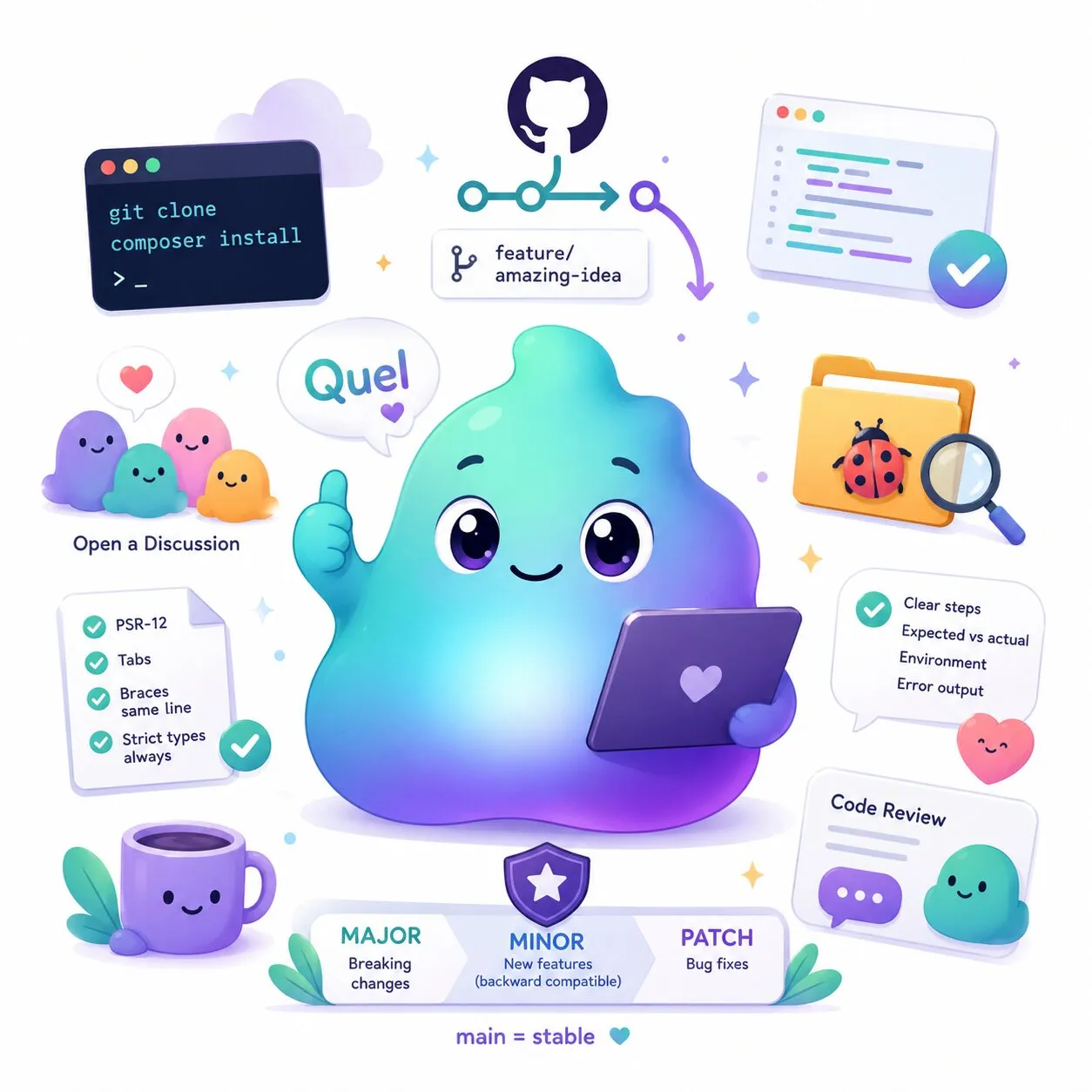
How to Contribute
Join the ObjectQuel community and help make it better. Learn how to contribute code, documentation, and improvements to the project.
Getting Started
Set up your development environment:
# Fork the repository on GitHub
# Clone your fork
git clone https://github.com/quellabs/objectquel.git
cd objectquel
# Install dependencies
composer update
# Set up environment
cp .env.example .env
Development Workflow
Follow our development process:
# Create a feature branch
git checkout -b feature/amazing-feature
# Make your changes
# Add tests for new functionality
# Update documentation if needed
# Run the test suite
./vendor/bin/pest
# Run code style checks
./vendor/bin/php-cs-fixer fix --dry-run
# Fix code style issues
./vendor/bin/php-cs-fixer fix
# Commit your changes
git add .
git commit -m "Add amazing new feature"
# Push to your fork
git push origin feature/amazing-feature
# Create a Pull Request on GitHub
Code Style Guidelines
ObjectQuel follows PSR-12 Extended Coding Style Guide with these key requirements:
- Use tabs for indentation, not spaces
- Opening braces for classes and methods go on the same line
- Always use strict types declaration
- Follow PascalCase for class names, camelCase for methods and properties
- Use UPPER_SNAKE_CASE for constants
- Include complete PHPDoc blocks for all classes and methods
Run ./vendor/bin/php-cs-fixer fix to automatically format your code according to project standards.
Testing Requirements
ObjectQuel uses Pest for testing. All contributions must include appropriate tests:
# Run all tests
./vendor/bin/pest
# Run specific test directories
./vendor/bin/pest tests/Unit
./vendor/bin/pest tests/Feature
# Run tests with coverage
./vendor/bin/pest --coverage
# Run tests in parallel (faster)
./vendor/bin/pest --parallel
Test Coverage Requirements
- New features: 90%+ coverage required
- Bug fixes: Test for the specific bug + regression tests
- Refactoring: Maintain or improve existing coverage
- Critical features: 100% coverage required
Generate coverage reports with ./vendor/bin/pest --coverage --min=80
Issue Reporting
Report bugs and request features effectively using our templates:
Bug Report Template
- Expected Behavior: Describe what you expected to happen
- Actual Behavior: Describe what actually happened
- Steps to Reproduce: Numbered list of reproduction steps
- Environment: ObjectQuel version, PHP version, database, OS
- Additional Context: Error logs, code examples, screenshots
Feature Request Template
- Feature Description: Clear description of the proposed feature
- Use Case: Explain why this feature would be useful
- Proposed Implementation: Optional implementation suggestions
- Alternatives Considered: Other approaches you've considered
Code Review Process
Participate effectively in the code review process:
As a Contributor
- Respond to feedback promptly and constructively
- Make requested changes in new commits (don't force-push after review starts)
- Be open to suggestions and improvements
- Ensure all tests pass before requesting review
As a Reviewer
- Be constructive and specific in feedback
- Focus on code quality, not personal preferences
- Test the changes if possible
- Approve when ready or clearly request changes
Review Checklist
- Code follows project standards
- Tests are comprehensive and passing
- Documentation is updated
- No performance regressions
- Security considerations addressed
- Backwards compatibility maintained
Community Guidelines
Be part of our welcoming community:
Code of Conduct
- Be respectful and professional
- Welcome newcomers and help them learn
- Focus on constructive feedback
- Assume good intentions
- Help others learn and grow
Communication Channels
- GitHub Issues: Bug reports and feature requests
- GitHub Discussions: Questions and community ideas
- Stack Overflow: Tag questions with 'objectquel'
Ways to Contribute
- Fix bugs and add new features
- Improve documentation and examples
- Write tutorials and guides
- Answer questions in the community
- Review pull requests from other contributors
- Test new releases and report issues
Release Process
Understanding our release workflow:
Semantic Versioning
We follow MAJOR.MINOR.PATCH versioning (e.g., 2.1.3):
- MAJOR: Breaking changes that require code updates
- MINOR: New features that are backwards compatible
- PATCH: Bug fixes that are backwards compatible
Release Schedule
- Major releases: Every 12 months
- Minor releases: Every 3 months
- Patch releases: As needed for critical bugs
Branch Strategy
- main: Stable release branch
- develop: Development branch for upcoming features
- feature/*: Individual feature branches
- hotfix/*: Critical bug fixes for immediate release
Getting Help
If you need assistance while contributing:
- Check the README.md for basic usage and setup
- Browse existing GitHub Issues for similar problems
- Start a GitHub Discussion for questions
- Review the codebase for examples and patterns
- Ask for help in your pull request if you get stuck
Thank you for considering contributing to ObjectQuel! Your contributions help make the project better for everyone.