 ️
️ Creating, Altering & Destroying Tables & Indexes
The create/alter/destroy and index/destroy ... on statements let you manage ad hoc tables and indexes — staging, archive, or audit tables — directly from ObjectQuel, without an entity class or a migration. They operate outside the entity-mapped schema: for tables you intend to keep and version long-term, prefer @Orm\Column/@Orm\Index annotations and Sculpt migrations instead.
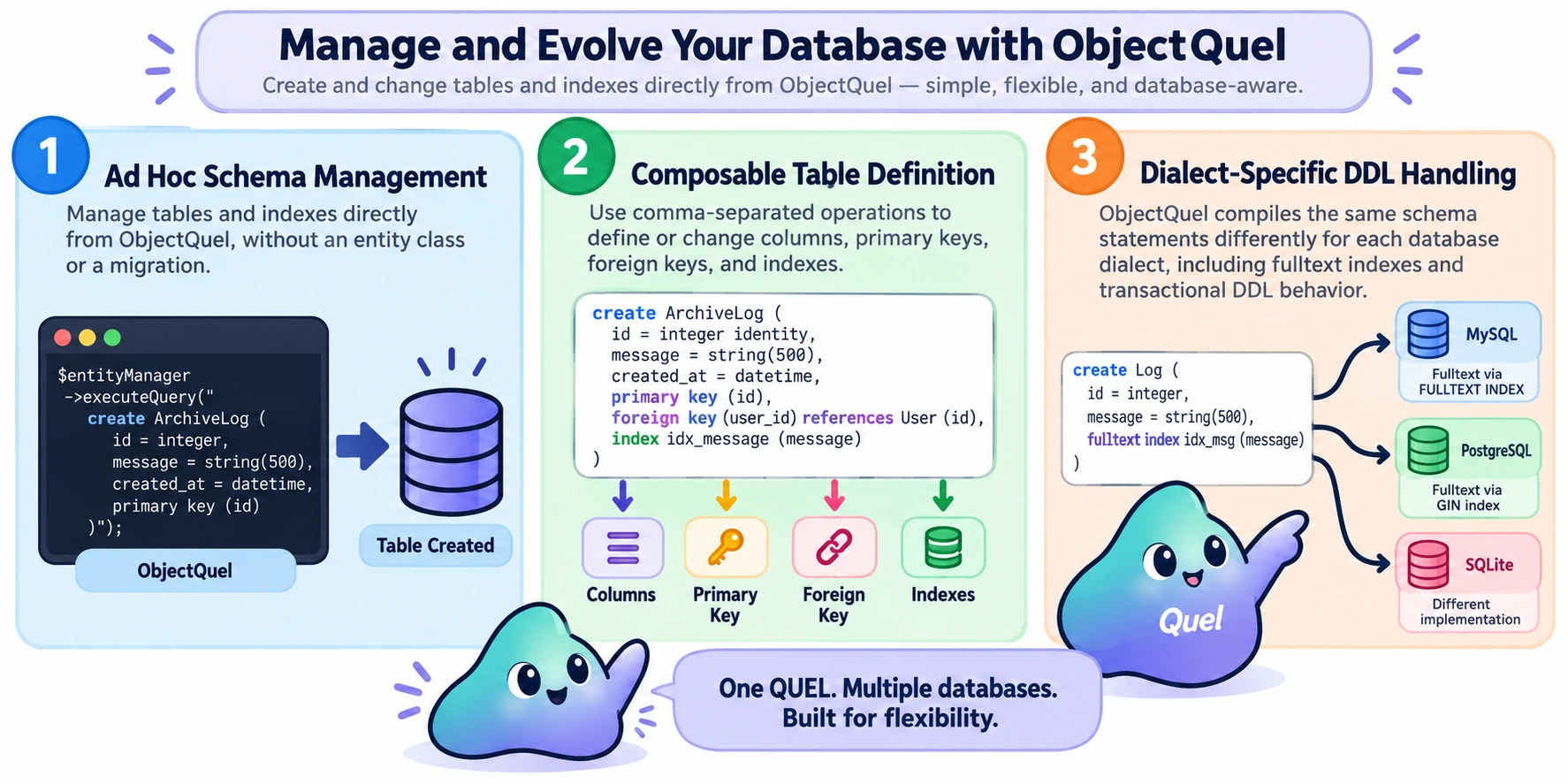
Creating Tables
create takes a table name followed by a parenthesized, comma-separated list. Entries may appear
in any order and repeat as needed — the list can hold any mix of the following:
| Entry | Description |
|---|---|
attr = type constraints |
A column definition — the same attr = value shape used throughout ObjectQuel. See Column Types and Constraints below. |
primary key (col, ...) |
Declares the table's primary key over one or more columns. See Primary Keys below. |
foreign key (col) references Table [(col)] [on delete action] [on update action] |
Declares a foreign key constraint on a column. See Foreign Keys below. |
[unique|fulltext] index name (col, ...) |
Declares an index on one or more columns. See Embedded Indexes below. |
$entityManager->executeQuery("
    create ArchiveLog (
        id = integer identity,
        message = string(500),
        created_at = datetime,
        primary key (id)
    )
");
create and destroy return no rows — executeQuery() returns
null for both.
Column Types
Column types are the same abstract vocabulary @Orm\Column annotations use (see
Annotations Reference). A length limit or decimal precision/scale follows
the type name in parentheses where noted below:
| Type | Parentheses | Description |
|---|---|---|
tinyinteger |
— | Smallest whole-number type — 1 byte on most engines. |
smallinteger |
— | Small whole-number type — 2 bytes on most engines. |
integer |
— | Standard whole-number type — 4 bytes on most engines. |
biginteger |
— | Large whole-number type — 8 bytes on most engines, for values beyond integer's range. |
float |
— | Approximate floating-point number. |
decimal |
(precision, scale) |
Exact fixed-point number — the right choice whenever rounding errors aren't acceptable (money, quantities). |
string |
(length) |
Variable-length text with a maximum length. |
char |
(length) |
Fixed-length text, padded to the declared length by the engine. |
text |
— | Unbounded variable-length text, with no length argument. |
boolean |
— | True/false value. |
date |
— | Calendar date, no time component. |
datetime |
— | Date and time. |
time |
— | Time of day, no date component. |
timestamp |
— | Date and time, distinct from datetime in range and storage on some engines. |
binary |
(length) |
Fixed- or variable-length raw binary data. |
blob |
— | Large binary object, with no length argument. |
json |
— | Structured data stored as JSON text — ObjectQuel decodes it to a PHP array on hydration and re-encodes it on persist. |
uuid |
— | Universally unique identifier, generated before insert rather than by the database. |
year |
— | Year-only value. |
enum |
('value', ...) |
A fixed list of quoted string values, e.g. enum('draft', 'published', 'archived'). Compiles to a real ENUM(...) on engines that support one natively (MySQL/MariaDB); elsewhere it falls back to VARCHAR, sized to fit the longest declared value with a minimum of 255, and the value list is not enforced by the database itself. |
set |
(length) |
Accepted as a type keyword; stored as a plain variable-length string of the given length. |
$entityManager->executeQuery("
    create Invoice (
        number = string(20),
        amount = decimal(10,2)
    )
");
Constraints
A column accepts any combination of the following, in any order. Columns are NOT NULL by
default, matching @Orm\Column's own nullable parameter — add nullable
to a column to allow NULL values:
| Constraint | Description |
|---|---|
nullable |
Allows NULL values. Columns are NOT NULL by default. |
identity |
Auto-increments the column. Must be the table's sole primary key column — see Primary Keys below. |
$entityManager->executeQuery("
    create Contact (
        email = string(255),
        phone = string(20) nullable
    )
");
unsigned precedes the type name — unsigned integer — mirroring C's declaration
order. A bare unsigned with no type name after it defaults to unsigned integer.
Declaring it on a type with no signed/unsigned distinction (string, for example) is rejected at
parse time regardless of target engine:
$entityManager->executeQuery("
    create Inventory (
        stock = unsigned,
        weight = unsigned decimal(8,2)
    )
");
Primary Keys
A primary key isn't a column-level constraint — it's declared with a standalone primary key (col, ...)
entry in the column list, in any position, listing one or more columns in physical key-column order:
$entityManager->executeQuery("
    create OrderLine (
        order_id = integer,
        line_no = integer,
        sku = string(20),
        primary key (order_id, line_no)
    )
");
identity requires a matching primary key (...) clause naming that column, and only
that column — otherwise the statement is rejected at parse time. Some engines (SQLite in particular) only
support auto-increment on the primary key column itself, and a composite key can't be auto-incremented on
any engine.
Foreign Keys
The column list may also contain any number of foreign key (col) references Table [(col)] [on delete
action] [on update action] entries, in any position — the same underlying grammar as
@Orm\ForeignKey/@Orm\ForeignKeyAction (see Foreign
Key Constraints), just spelled as DDL instead of an annotation:
$entityManager->executeQuery("
    create OrderTable (
        customer_id = integer,
        foreign key (customer_id) references Customer (id) on delete cascade
    )
");
The referenced column may be omitted — references Customer then resolves to the target table's
own primary key automatically. This only works when that primary key is a single column; a target with no
primary key, or a composite one, is rejected with an error telling you to name the column explicitly:
$entityManager->executeQuery("
    create Shipment (
        customer_id = integer,
        foreign key (customer_id) references Customer
    )
");
on delete/on update may appear in either order, or be omitted entirely — omitted,
they default to RESTRICT/NO ACTION respectively, matching
@Orm\ForeignKeyAction's own defaults. Valid actions are restrict,
cascade, set null, and no action.
@Orm\ForeignKey's own single-referencedColumn limit.
Embedded Indexes
The column list may also contain [unique|fulltext] index name (col, ...) entries — the same
grammar as the standalone index statement further down this page, minus the on Table
is phrasing, which is redundant once already scoped to the table being created:
$entityManager->executeQuery("
    create Catalog (
        sku = string(20),
        tenant_id = integer,
        description = text,
        unique index catalog_sku_uniq (sku),
        index catalog_tenant_idx (tenant_id),
        fulltext index catalog_description_idx (description)
    )
");
Each entry is assembled into a real, separate index-creation statement behind the scenes — functionally
identical to writing the standalone index statement afterward, just declared in one place
instead of several.
Temporary Tables
Add temporary right after create for a session-scoped table — visible only to the
current connection, and gone once the connection closes:
$entityManager->executeQuery("
    create temporary StagingTotals (
        user_id = integer,
        total = decimal(10,2)
    )
");
Disposal is always explicit — drop a temporary table with destroy when you're done with it, or
let it disappear with the connection.
if not exists
Append if not exists to make create a no-op instead of an error when the table is
already there:
$entityManager->executeQuery("
    create ArchiveLog (id = integer) if not exists
");
Destroying Tables
destroy drops a table by name. Without if exists, dropping a name that doesn't
resolve to a real table raises an error. Each statement targets exactly one table; drop several tables with
several statements:
$entityManager->executeQuery("destroy SessionLog");Temporary Tables
Add temporary when the target is a session-scoped table created with create temporary.
An unqualified destroy already finds a same-named temporary table on its own, so
temporary isn't strictly required — but writing it removes any ambiguity about which table is
meant, and is recommended when you know the target is temporary:
$entityManager->executeQuery("destroy temporary StagingTotals");if exists
Append if exists to make destroy a no-op instead of an error for a missing table:
$entityManager->executeQuery("destroy SessionLog if exists");Altering Tables
alter Name (op {, op}) changes an existing table's shape. Each parenthesized, comma-separated
entry is a single-purpose sub-operation — a rename, a retype, or a constraint change, each kept distinct:
$entityManager->executeQuery("
    alter Employee (
        add department = string(100),
        drop legacy_code,
        rename hire_date to hired_at,
        retype hired_at = datetime
    )
");| Sub-operation | Effect |
|---|---|
add attr = type constraints [backfill 'value'] |
Adds a column. Same attr = type constraints grammar as create's column list, plus an optional trailing backfill clause — see Backfilling Added Columns below. |
drop attr |
Drops a column by name. |
rename oldAttr to newAttr |
Renames a column, always written explicitly as old name to new name. |
retype attr = type constraints |
Changes a column's type/constraints in place, leaving its name untouched. |
primary key (col, ...) |
Adds or replaces the table's primary key. |
drop primary key |
Drops the table's primary key. |
add [unique|fulltext] index name (col, ...) |
Adds an index. Same grammar as the standalone index statement below, minus on Table is. |
drop index name |
Drops an index by name. |
add foreign key (col) references Table [(col)] [on delete action] [on update action] |
Adds a foreign key. Same grammar — and same column-less-reference resolution — as create's embedded foreign key entry. |
drop foreign key (col) |
Drops the foreign key declared on the named local column. |
$entityManager->executeQuery("
    alter Employee (
        drop primary key,
        primary key (employee_no),
        add unique index employees_email_uniq (email),
        drop index employees_legacy_idx
    )
");
$entityManager->executeQuery("
alter Payment (
add foreign key (invoice_id) references Invoice (id) on delete cascade
)
");
$entityManager->executeQuery("
alter Payment (
drop foreign key (invoice_id)
)
");alter targets exactly one table per statement, matching create/destroy's
one-object invariant — several changes to the same table go in one statement's operation list.
Backfilling Added Columns
Adding a NOT NULL column to a table that already has rows normally fails — the engine has no
value to put in the new column for rows that already exist. A trailing backfill 'value' clause on
add solves this by populating existing rows with a literal value as part of the same operation:
$entityManager->executeQuery("
    alter Order (
        add status = string(20) backfill 'pending'
    )
");
The value is always written as a quoted string literal, whatever the column's actual type — backfill
'0' for an integer column, not backfill 0. Under the hood, the column is added with a
transient DEFAULT so existing rows pick it up, then the default is dropped again immediately —
it exists only to seed old rows, not as a second, persisted source of truth alongside an entity's own
@Orm\Column(default=...).
ALTER COLUMN to drop the default afterward, so the
default is deliberately left in place there instead of removed. It's harmless — ObjectQuel never reads a
column's database-level default — but worth knowing if you inspect the schema directly.
make:migrations (see Sculpt) generates this clause automatically
when it detects a new non-nullable column being added to a table that already has rows, using the entity's
declared @Orm\Column(default=...) as the backfill value. If the entity declares no default,
generation fails with an error telling you to add one or write the migration by hand.
Transactional DDL
On platforms that support transactional DDL — pgsql, sqlite, sqlsrv — the statements compiled from a single
create or alter call run wrapped in one transaction: if any statement in the
sequence fails (say, a trailing embedded index entry, after the table itself was already created), everything
already applied for that call rolls back. mysql/mariadb commit each DDL statement as it runs, so on those
engines a failed alter call can leave its earlier sub-operations applied. create
handles this case by dropping the table it just created on failure (unless if not exists matched
an already-existing table), simulating a rollback on engines that don't provide one natively. Standalone
index/destroy ... on statements always run outside a transaction, on every dialect.
Creating Indexes
index creates a single index on any table by name, whether entity-mapped or ad hoc — the
compiler resolves it purely by name. The keyword order reads as index on Table is name (cols):
$entityManager->executeQuery("index on AuditEvent is audit_event_created_idx (created_at)");Add unique right after index for a uniqueness constraint, and list more than one column for a composite index:
$entityManager->executeQuery("index unique on Products is products_sku_uniq (sku)");

$entityManager->executeQuery("index unique on Products is products_tenant_sku_idx (tenant_id, sku)");
Fulltext Indexes
fulltext occupies the same slot as unique — at most one of the two may be given,
since no target dialect has a "unique fulltext" concept:
$entityManager->executeQuery("index fulltext on ArticleEntity is article_body_fulltext_idx (title, body)");What this compiles to is materially different per dialect, though the QUEL syntax above is identical everywhere:
| Dialect | What actually gets created |
|---|---|
| mysql / mariadb | A real, named CREATE FULLTEXT INDEX. |
| pgsql | A GIN expression index over to_tsvector('english', ...) across the given columns. |
| sqlsrv |
A shared fulltext catalog is bootstrapped once, then a fulltext index is created against it. SQL
Server requires an existing unique or primary key index on the table to key the fulltext index
against — ObjectQuel resolves this automatically via schema introspection, but the table must
already have one. T-SQL fulltext indexes are also unnamed (one per table); ObjectQuel tags the
QUEL name onto the table as a SQL Server extended property so destroy (below) can
still find it by name.
|
| sqlite | An FTS5 external-content virtual table, physically named after the QUEL index name, kept in sync with the base table via three triggers. Also requires the base table to already have a primary key column. |
search()/
search_score() — see Searching.
Destroying Indexes
destroy Name on Table drops a single index — the trailing on Table clause is what
distinguishes an index destroy from the table form above; no separate keyword is needed:
$entityManager->executeQuery("destroy audit_event_created_idx on AuditEvent");

// No-op instead of an error if the index doesn't exist
$entityManager->executeQuery("destroy audit_event_created_idx on AuditEvent if exists");
Like destroy for tables, this targets exactly one index per statement — no comma-separated
list. Without if exists, an unknown index name surfaces the underlying engine's own error
rather than a synthetic one.
DROP INDEX lacks native IF EXISTS support (MariaDB has it).
ObjectQuel emulates it there with a small dynamic-SQL check, so if exists behaves identically
on every dialect.
Destroying a fulltext index uses this same statement on every dialect. On mysql/mariadb/pgsql a fulltext index is a real, named index, so it drops exactly like a plain one. On sqlsrv/sqlite — where a fulltext index isn't an ordinary named object — ObjectQuel resolves the name automatically (via the extended property tag and FTS5 virtual table lookup described above) before dropping it; a name that doesn't resolve falls through to the same "unknown index" error a typo would produce anywhere else.
Scope & Limitations
- No default values on
create's oralter's column definitions — a column with no value supplied onappendmust be declarednullable, or the statement is rejected. - Foreign keys are single-column on both sides — no composite foreign keys, matching
@Orm\ForeignKey's own limit. altertargets exactly one table per statement, and each sub-operation is single-purpose — renaming and retyping a column are always separate operations.create/alter/destroy/indexaren't restricted to non-entity-mapped tables, but using them against a table an entity class also manages bypasses migrations entirely — not recommended.